If War Destroys Internet Infrastructure, Is Bitcoin Safe?
Mar 20 2026
As tensions rise in the Middle East and threats to global infrastructure become more prominent, a critical question emerges: If the submarine cables handling 99% of global data traffic are physically attacked, will the Bitcoin network remain secure?
Bitcoin’s Survival: 72% of Submarine Cables Must Fail Simultaneously
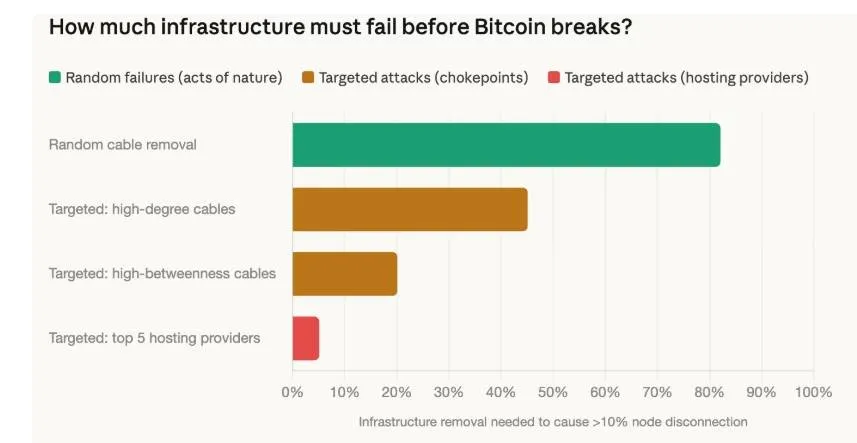
Researchers at the Cambridge Centre for Alternative Finance (CCAF) recently published a study on how internet disruptions affect Bitcoin. The conclusion? A severe node partition only occurs if at least 72% to 92% of submarine cables are destroyed simultaneously.
Historical data supports this resilience. Most cable failures over the past 11 years had zero impact on the network. Even during the massive 2024 Ivory Coast undersea seismic event—the largest single cable failure incident—only 5 nodes (0.03% of the network) were affected.
The Power of Decentralized Nodes
Nodes are the backbone of Bitcoin, individual computers that verify and record transactions in a P2P fashion. If nodes disappear, the network slows down and becomes vulnerable. However, with tens of thousands of nodes webbed across the globe, random failures rarely cause significant disruption.
Vulnerability to Targeted Attacks
While random failures are unlikely to take down Bitcoin, targeted attacks are a different story.
Transit Hubs: If attackers target specific "high-betweenness" cables (key transit routes), damaging just 20% could severely impact the network.
Hosting Providers: Attacking the top 5 hosting providers (Hetzner, OVH, Comcast, Amazon, Google Cloud) could cripple the network by removing just 5% of routing capacity.
Geographic Distribution & Resilience
Bitcoin’s resilience (measured between 0.90–0.92) peaked during 2014–2017 when nodes were highly dispersed. It dropped to its lowest (0.72) in 2021 due to mining concentration in East Asia. Following China’s mining ban, nodes redistributed globally, with resilience recovering to 0.88 in 2022 and maintaining 0.78 in 2025.
The Unsung Hero: TOR Nodes
The study found that TOR (The Onion Router) nodes significantly boost stability. By 2025, 64% of Bitcoin nodes used TOR, making their physical location untraceable.
TOR relay infrastructure is concentrated in Germany, France, and the Netherlands—countries with the highest global connectivity, making them nearly impossible to disconnect.
Using TOR increases Bitcoin's network resilience fivefold compared to the standard internet.
Conclusion: Unless a state-level actor executes a precision strike on specific transit hubs and major hosting providers, the Bitcoin network will likely remain unaffected by physical infrastructure damage.
Source: Image 1 (CANVA), Image 2 (COINDESK) By. Coinness Content Team