SEC and CFTC Collaboration on Crypto: A Turning Point for the Market?
Mar 20 2026
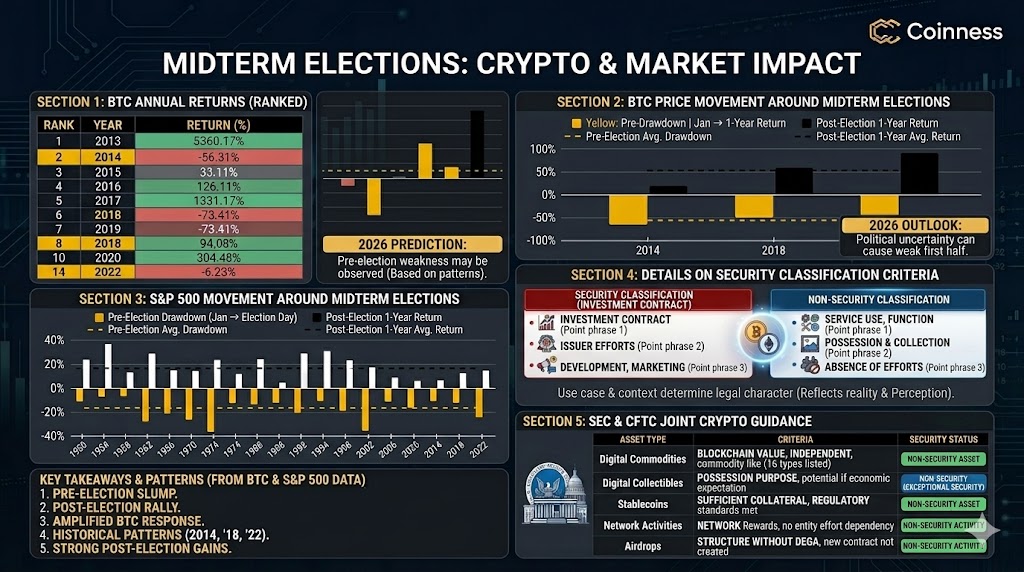
The debate over whether cryptocurrencies are "securities" or "commodities" has been the most critical issue since the market's inception. Classification as a commodity rather than a security significantly eases the regulatory burden, as securities face strict SEC registration and disclosure requirements, whereas commodities enjoy a more flexible environment under the CFTC.
Recently, the SEC and CFTC announced joint guidance, clarifying that they will not view all cryptocurrencies as securities. While not legally binding, it sets a clear direction for future regulatory interpretation.
Key Highlights of the Joint Guidance
1) Reorganization of Token Classification The guidance classifies Digital Commodities, Digital Collectibles, Digital Tools, and Payment Stablecoins (under the GENIUS Act) as non-security assets in principle.
Digital Commodities: Assets like Bitcoin, where value stems from the network without centralized control. Notably, 16 assets including BTC, ETH, SOL, XRP, ADA, AVAX, LINK, and DOGE were designated as commodities, transferring jurisdiction to the CFTC.
Digital Collectibles (NFTs): Generally not seen as securities unless they promise profits based on project growth.
Stablecoins: Assets like USDC with sufficient collateral are explicitly excluded from being classified as securities.
2) Clarity on Staking and Airdrops Activities such as staking, mining, airdrops, and wrapped tokens are generally not considered securities. These are viewed as network reward mechanisms or technical processes rather than investment contracts.
3) Specific Criteria for "Security" Status The SEC will focus on the economic context and investor expectations rather than technical form. If a project messages that it will drive value through its own marketing or development efforts, it is more likely to be seen as an investment contract.
Expected Market Changes
This shift, led by SEC Chairman Paul Atkins’ industry-friendly approach, is expected to resolve "Compliance Discounts" (undervalued assets due to regulatory risk) and lower barriers for institutional investors.
Conclusion: While some point out the lack of legal binding power, the industry reaction is overwhelmingly positive. Ripple CLO Stuart Alderoty welcomed the move, thanking the SEC for providing the regulatory clarity that innovators have long demanded.
By. Coinness Content Team