Publicly Traded Companies Whose Primary Business is 'Buying Crypto'? – The World of DAT
Mar 10 2026
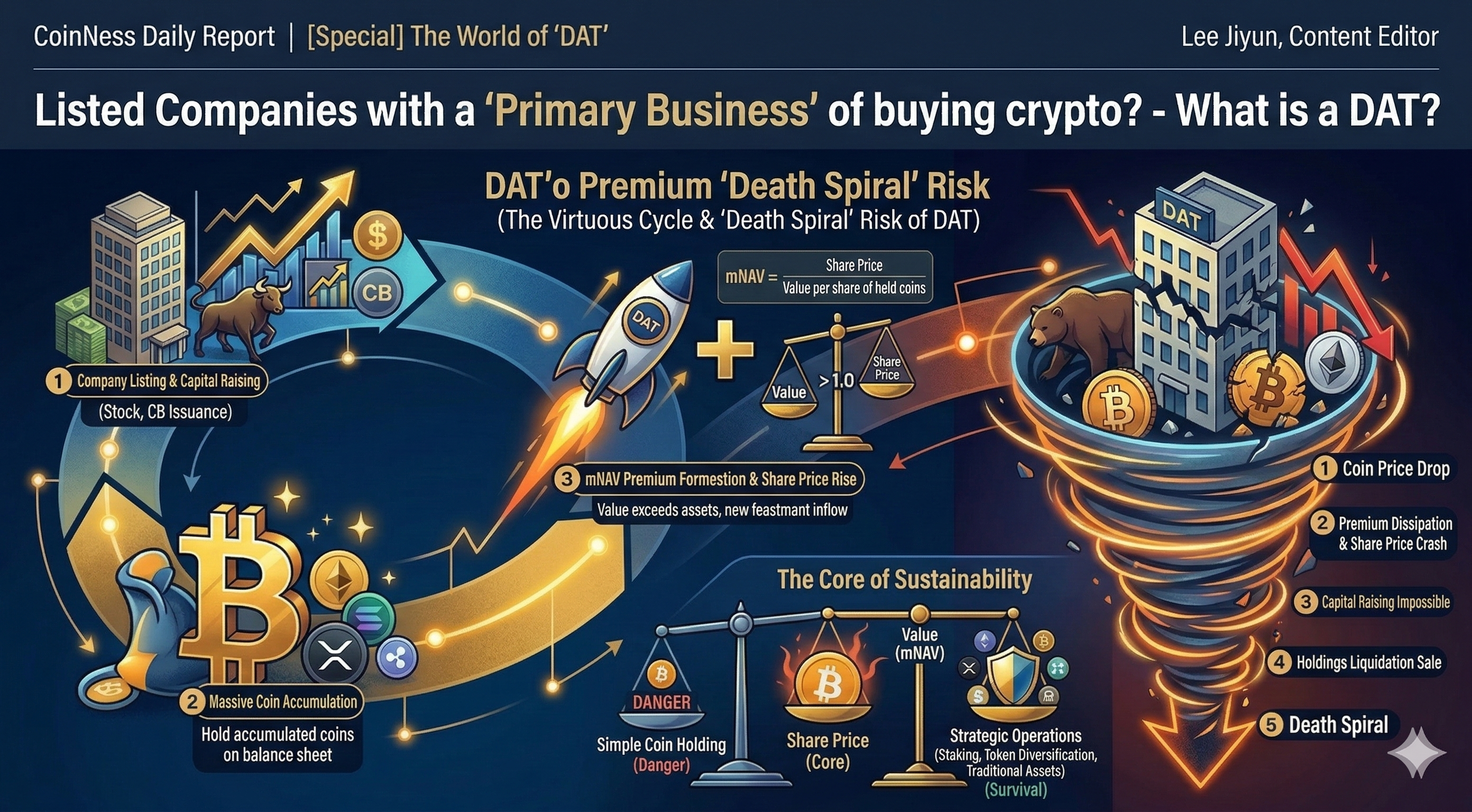
Cryptocurrency is no longer just for the tech-savvy; the term DAT is appearing frequently in legacy media. This is because DATs are bridge the gap between crypto and the traditional stock market, and their scale has grown enough to significantly influence market liquidity. Here is an overview of what DAT is and how it impacts the market.
What is DAT (Digital Asset Treasury)?
DAT stands for Digital Asset Treasury company. In this context, it refers specifically to publicly traded companies that make cryptocurrency a core part of their corporate strategy. They hold crypto on their balance sheets and are legally required to transparently disclose their holdings and trading activities.
The DAT model was pioneered in 2020 by MicroStrategy (led by Michael Saylor). As of March 2, 2026, MicroStrategy holds over 720,000 BTC. Its success has led more than 200 public companies to adopt the DAT model.
While 90% of DATs focus on Bitcoin (holding a combined 1.13 million BTC, or 5% of the total supply), others focus on altcoins:
Ethereum (ETH): The second most popular asset. Bitmine, led by Tom Lee, holds over 4.47 million ETH.
Solana (SOL): The third most popular, with DATs holding approximately 16 million SOL.
Others: XRP, DOGE, BNB, and ADA are also held, though in smaller quantities.
Why Investors Buy DAT Stocks Instead of Coins
Investors can gain indirect exposure to crypto through traditional brokerage accounts. This is a crucial entry point for institutional investors (like pension funds) that may face regulatory hurdles in holding crypto directly.
Security: No need for self-custody; no risk of losing private keys or being hacked.
Leverage: DATs often use leverage, allowing for potentially higher returns than the underlying asset (though with higher risk).
DAT vs. ETF: What’s the Difference?
ETFs (Exchange Traded Funds): Passive instruments designed to track the price of the underlying asset. Issuers buy or sell crypto only when investors buy or sell the ETF. They require SEC approval.
DATs: Active entities that aim to continuously accumulate crypto regardless of stock trading volume. They raise capital through stock issuance or convertible bonds to buy more coins.
Key Concept: mNAV (Multiple of Net Asset Value)
mNAV is a critical metric for DAT investors.
NAV (Net Asset Value): The value of the crypto held per share.
mNAV: The ratio of the stock price to the NAV.
mNAV > 1.0: The stock is trading at a Premium.
mNAV < 1.0: The stock is trading at a Discount. A high mNAV reflects bullish market sentiment and enhances the company's ability to raise new capital.
The Virtuous Cycle vs. The Death Spiral
In a Bull Market, DATs enjoy a "Virtuous Cycle":
Rising Crypto Price → Rising Stock Price → High mNAV Premium → New Capital Raising (ATM offerings) → More Crypto Purchases.
However, a Bear Market can trigger a "Death Spiral":
Crypto prices and stock prices drop simultaneously.
The premium disappears, making it impossible to raise capital for further purchases.
Without other revenue streams, DATs may be forced to sell their crypto holdings to cover operating costs or buy back shares.
Sustainability and Market Concerns
The market is particularly concerned about MicroStrategy. As the "bellwether" of DATs, any signs of weakness could freeze investor sentiment. Since MicroStrategy used debt (convertible bonds) to buy Bitcoin, it may be forced to liquidate holdings if BTC prices stay below its average entry price ($75,985) for an extended period.
The Bottom Line: Experts suggest that only DATs with diversified strategies—such as staking for yield, diversifying token holdings, or mixing crypto with traditional assets like Treasury bonds—will survive long-term. The sustainability of a DAT depends not on "how many coins it owns," but on "how it survives a downturn."
By Jiyun Lee, CoinNess Content Editor