Prediction Markets: Is There a Winning Strategy for Guaranteed Profits?
Mar 18 2026
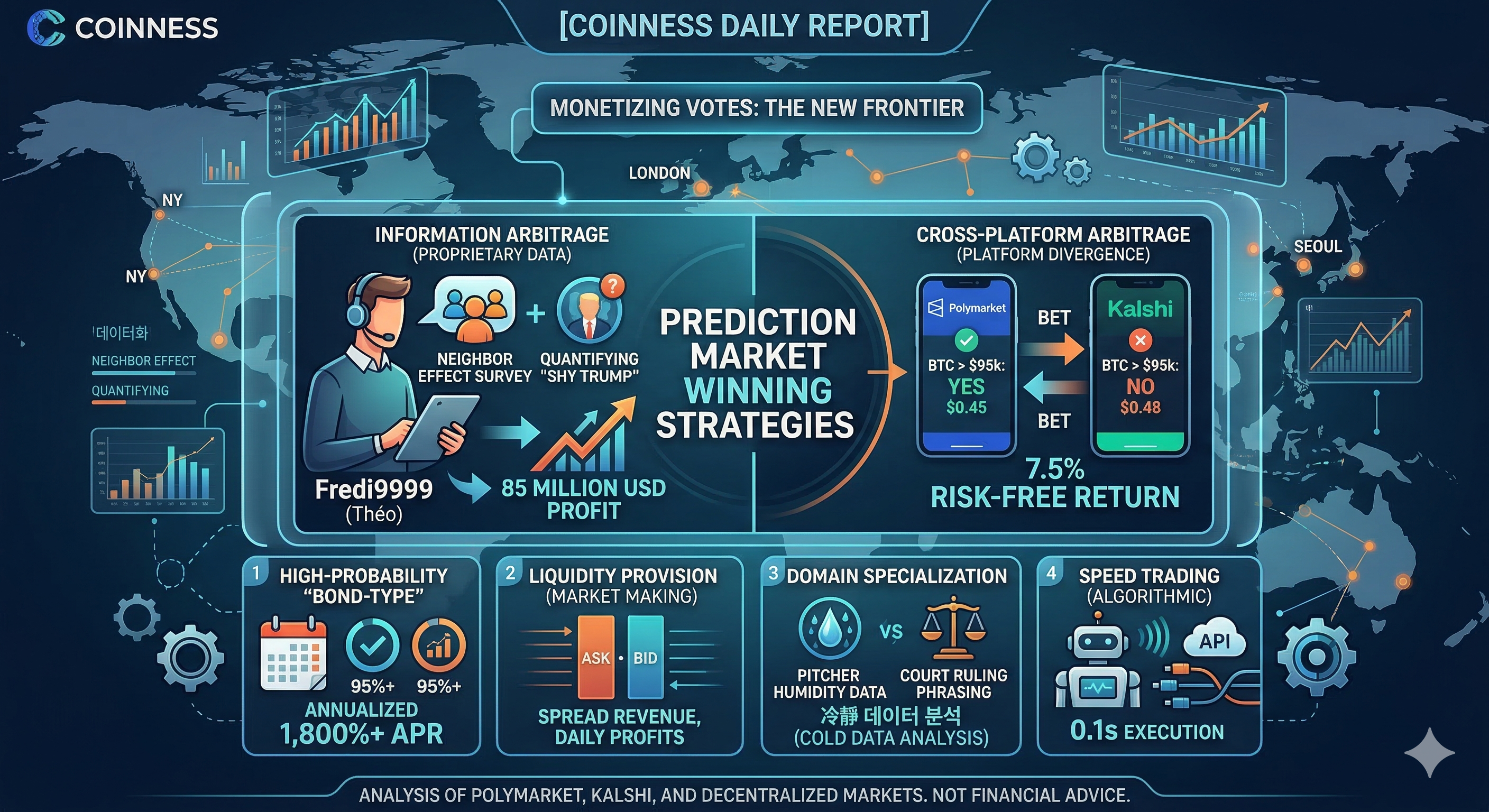
On the night of the 2024 U.S. Presidential Election, a French trader realized a net profit of $85 million on Polymarket. This figure surpasses the annual performance of most mid-sized hedge funds.
With over $9 billion in cumulative trading volume and 314,000 active traders, the decentralized prediction market Polymarket is redefining the boundaries of "voting with money."
But can anyone easily make money in these markets?
In reality, prediction markets are a zero-sum game. Data shows that only 0.51% of Polymarket wallets achieved profits exceeding $1,000.
So, what did the winners do differently?
1. Information Arbitrage Strategy
The French trader known as "Fredi9999" (Théo) spent $100,000 of his own money to commission a private poll through YouGov. Instead of asking, "Who will you vote for?", he asked, "Who do you think your neighbor will vote for?" By quantifying the "Shy Trump" effect through this unique data, he bet $80 million and walked away with an $85 million profit.
The Core: This isn't just about reading news faster; it’s about generating proprietary data that proves errors in existing mainstream data.
The Logic: Mainstream polls are often distorted by "social desirability bias" or "sampling bias." Théo utilized the "Neighbor Effect," a psychological principle where people tend to describe their surroundings objectively even when concealing their own intentions.
The Play: While the market prices an event at a 50% probability ($0.50), a trader uses "on-the-ground research" to identify a true 70% probability ($0.70) and bets aggressively on the discrepancy.
2. Cross-platform Arbitrage Strategy
This involves securing guaranteed profits by placing opposite bets on different platforms when prices for the same event diverge.
Example: If Polymarket lists "Bitcoin surpassing $95k (YES)" at $0.45, while Kalshi lists the "NO" option at $0.48, an investor can bet on both to lock in a nearly 7.5% risk-free return.
The Logic: Even for the same event (e.g., a Fed rate cut), Polymarket might settle based on "Official Fed Press Releases," while Kalshi might use "Specific Financial News Wire reports." Temporary price gaps occur when one source reports faster than the other.
3. High-probability "Bond-type" Strategy
This strategy involves betting large capital on outcomes that are virtually certain, typically at a win rate of over 95% (priced at $0.95 or higher).
The Methodology: Buying a "YES" share at $0.95 just before a confirmed event and receiving $1.00 a few days later. While the nominal return is ~5%, the annualized return (APR) can exceed 1,800% when factoring in compound interest and capital turnover.
The Focus: It is about capital velocity, not high margins. Even a $0.01 profit on a $1.00 investment is lucrative if the capital is only locked for 24 hours.
4. Liquidity Provision (Market Making) Strategy
Instead of being the gambler, you become the "Casino." This involves submitting both buy and sell orders simultaneously to capture the spread (price difference).
The Logic: Prediction markets are often Order Book-based. By providing liquidity, you earn the difference between the Bid and Ask prices without needing to predict the market direction.
The Advantage: New markets often have low liquidity and wide spreads. Top players using automated Market Making (AMM) systems can average $700–$800 in daily profits. Platforms like Polymarket often provide additional incentives (subsidies) to these liquidity providers.
5. Domain Specialization
This is the path of the Specialist rather than the Generalist—maximizing profits by dominating a specific niche.
The Difference: While a generalist might bet on a team based on a winning streak, a specialist analyzes granular metrics such as "a pitcher's performance in high-humidity weather" or "a batter's success rate against a specific pitch type."
The Play: Experts analyze injury histories, past speech patterns of politicians, or subtle phrasing changes in court rulings. When the mass market moves emotionally toward a popular side, the specialist uses cold data to find the "Value" on the opposite side.
6. Speed Trading Strategy
Executing trades within seconds—or milliseconds—before information is fully baked into the market price.
The Execution: Algorithmic investors use APIs to place orders the instant a specific keyword is uttered during a Fed Chair's speech.
The Result: Between 2024 and 2025, algorithmic traders earned approximately $4.2 million using this method. Due to high institutionalization, the barrier to entry for individuals is now extremely high.
The Tech: High-performance servers and automation scripts (e.g., Python) are essential to intercept news as "data" rather than "text," capturing favorable prices before the general public even processes the headline.
By. Coinness Content Team